Three Domains, One Method: How Spec-Driven Workflows Are Transforming Product, Content, and Marketing
The challenge facing professionals across disciplines is remarkably similar: how to harness AI agents effectively without losing strategic control or professional judgment.
Whether you're a product manager chasing product‑market fit, a content strategist trying to publish 3–5x more without sacrificing quality, or a marketing leader fighting to stay consistent on social, the real challenge isn't using AI agents—it's harnessing them without losing strategic control or professional judgment.
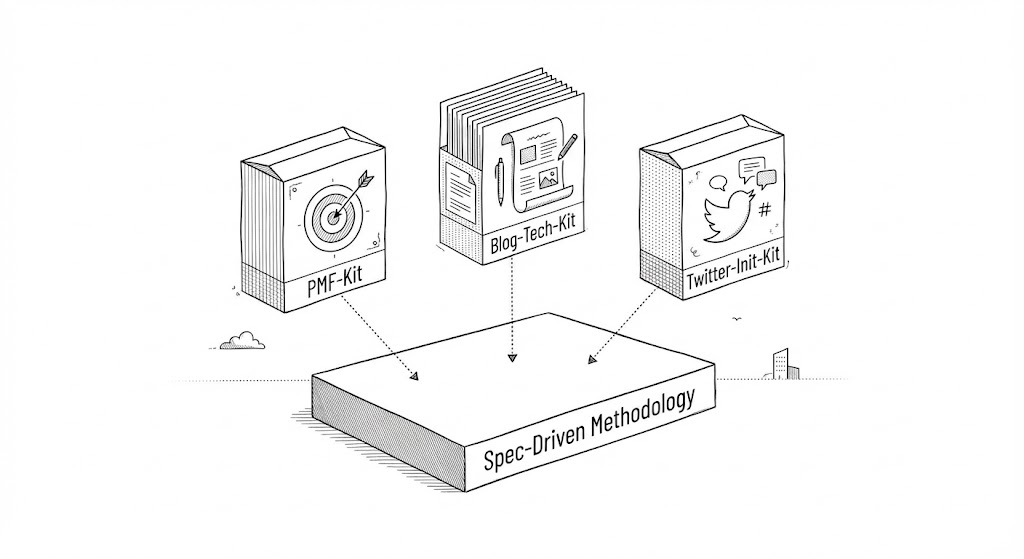
Three specialized toolkits—PMF‑Kit, Blog‑Tech‑Kit, and Twitter‑Init‑Kit—show how a single, spec‑driven methodology can cut PMF discovery cycles by months, multiply content output with the same team, and sustain authentic, founder‑led engagement on social. Each kit adapts the same specification‑driven approach to its domain, turning scattered AI experiments into systematic, agent‑ready workflows.
The Common Challenge: From Improvisation to Intention
Across product management, content creation, and marketing disciplines, professionals face a consistent pattern of friction:
Traditional Approach:
- Ad-hoc processes that depend on individual expertise
- Inconsistent outcomes across team members
- Knowledge trapped in people's heads rather than systems
- Difficulty scaling without proportional headcount increases
- AI tools used reactively rather than strategically
The Cost:
- Product teams waste months pursuing unvalidated hypotheses
- Content operations struggle to maintain quality at scale
- Marketing campaigns lack systematic rigor and repeatability
- Organizational knowledge disappears when key people leave
- AI capabilities remain underutilized or misapplied
The solution emerging across these domains shares a common foundation: specification-driven workflows that transform implicit expertise into explicit, agent-executable processes.
The Spec-Driven Foundation: A Unified Methodology
Before exploring how each kit adapts this approach, understanding the core methodology reveals why it works across such different professional contexts.
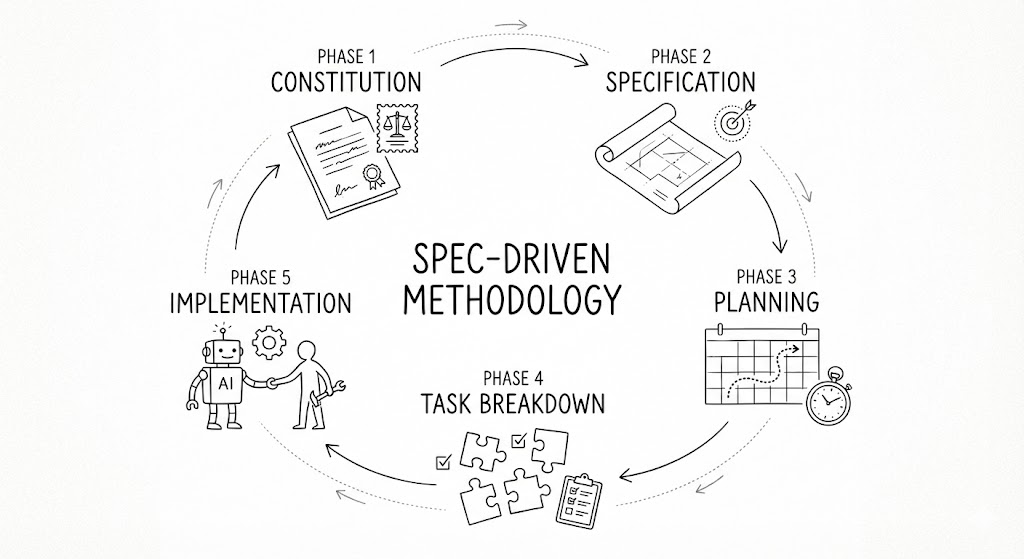
The Five-Phase Workflow
All three kits implement the same fundamental structure:
Phase 1: Constitution — Establish principles and boundaries
- Define immutable standards for quality and decision-making
- Set strategic constraints that guide all subsequent work
- Encode organizational values and professional judgment
- Create guardrails that prevent agent drift and misalignment
Phase 2: Specification — Articulate intent with precision
- Define what outcome you're pursuing and why it matters
- Identify assumptions that need validation
- Establish success criteria and measurement approaches
- Create the authoritative "source of truth" for the initiative
Phase 3: Planning — Design the execution approach
- Break down strategic intent into operational methodology
- Identify resources, dependencies, and integration points
- Map the path from current state to desired outcome
- Establish validation checkpoints and iteration triggers
Phase 4: Task Breakdown — Generate actionable steps
- Translate plans into discrete, executable tasks
- Sequence work to respect dependencies and priorities
- Assign clear ownership and completion criteria
- Enable parallel execution where appropriate
Phase 5: Implementation — Execute with AI assistance
- Leverage agents for accelerated execution within defined parameters
- Maintain human oversight at strategic decision points
- Collect evidence and validate against success criteria
- Iterate based on outcomes and learnings
Why This Structure Works Across Domains
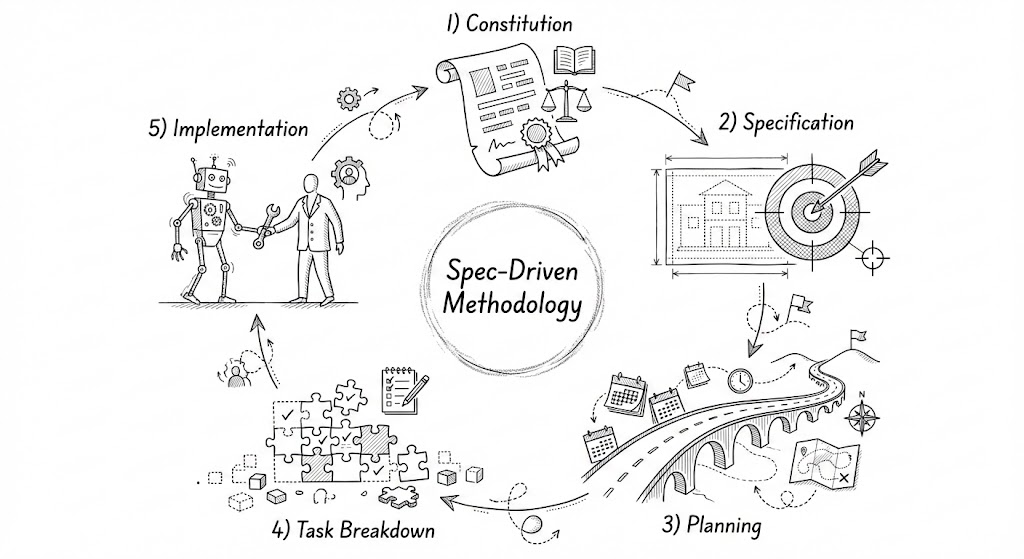
Separation of Strategy and Execution: Professionals retain control over "what" and "why" while agents accelerate "how" within defined boundaries.
Progressive Refinement: Each phase adds specificity, reducing ambiguity before committing resources to execution.
Knowledge Capture: Explicit specifications create organizational assets that persist beyond individual contributors.
Quality Through Process: Structured workflows with validation checkpoints ensure consistent outcomes regardless of who executes.
Scalable Leverage: Clear specifications enable AI agents to multiply professional capacity without proportional cost increases.
PMF-Kit: Systematic Product-Market Fit Discovery
For: Product managers, founders, innovation leads
The Domain Challenge: Product-market fit discovery has traditionally been more art than science—equal parts customer intuition, market sensing, and experimental iteration. Teams often pursue product hypotheses for months without systematic validation, resulting in wasted resources and missed opportunities.
The Spec-Driven Transformation:
Constitution Phase: Product teams establish their PMF discovery principles—target customer segment boundaries, validation criteria for different PMF stages (nascent → developing → strong → extreme), constraints around resources and timelines, and core assumptions about the problem space.
Specification Phase: Rather than vague product concepts, teams create precise hypotheses:
- Target Personas: Detailed profiles including role, environment, existing tools, and pain points
- Jobs-to-be-Done: Specific outcomes customers are trying to achieve
- Hero Workflows: 1-2 critical use cases that must work exceptionally well
- Success Metrics: Activation, engagement, AI-specific indicators, and business outcomes
- Risks and Constraints: Known limitations, competitive dynamics, and distribution hypotheses
Planning Phase: The kit generates a structured research methodology:
- Interview protocols with specific validation questions
- Sample sizes and recruitment strategies
- Evidence collection instruments (surveys, usage analytics, behavioral tracking)
- Analysis approaches for synthesizing qualitative and quantitative data
- Validation checkpoints for go/no-go decisions
Task Breakdown: Concrete research activities emerge:
- Recruit 15-20 target customers matching persona criteria
- Conduct 30-minute problem validation interviews
- Prototype minimum viable solution for hero workflow testing
- Run two-week usage pilots with 10 early adopters
- Analyze behavioral data against activation and engagement metrics
- Document evidence for PMF stage assessment
Implementation: AI agents accelerate execution while humans maintain judgment:
- Agents draft interview guides, analyze conversation transcripts, identify patterns in customer feedback
- Humans conduct interviews, interpret nuanced responses, make strategic pivots
- Shared specifications ensure team alignment as understanding evolves
The Professional Impact:
Product managers report 6-12 month acceleration in PMF discovery through systematic validation rather than intuition-driven iteration. The structured approach surfaces invalidating evidence earlier, preventing resource waste on low-potential directions.
Most importantly, specifications create a durable record of customer learning that persists as team composition changes—organizational knowledge becomes an asset rather than disappearing with departing employees.
Blog-Tech-Kit: Strategic Content Authority Building
For: Content strategists, marketing directors, thought leadership teams
The Domain Challenge: Building authority through technical content requires balancing strategic consistency with production velocity. Traditional approaches struggle with either maintaining quality at scale (when relying on freelancers) or achieving sufficient output (when depending on internal experts' limited bandwidth).
The Spec-Driven Transformation:
How the Five Phases Apply: Using the same five-phase workflow introduced earlier, the kit re-architects content operations:
- Constitution → Encode brand voice, technical depth, quality thresholds, SEO standards, and audience boundaries as non-negotiable guardrails.
- Specification → Turn ad-hoc topics into a coherent strategy: blog type, target audience, content pillars, cadence, success criteria, and distribution requirements.
- Planning → Define repeatable editorial workflows, research and review standards, SEO checklists, distribution playbooks, and analytics instrumentation.
- Task Breakdown → Translate plans into sprints and individual pieces: platform setup, foundation posts, recurring production cycles, validation checkpoints, and performance reviews.
- Implementation → Let agents draft, optimize, and generate distribution copy while humans enforce accuracy, nuance, and brand consistency within the constitutional constraints.
The Professional Impact:
Content leaders report 3-5x increase in publication frequency while maintaining or improving quality. The structured approach enables non-writers (technical experts) to contribute effectively by providing clear specifications rather than requiring polished prose.
Perhaps more significantly, the specification-driven approach shifts content from tactical execution to strategic asset development. Content pillars aligned with business positioning create compounding authority rather than random blog posts producing temporary traffic spikes.
Twitter-Init-Kit: Founder-Led Audience Development
For: Marketing leads, growth strategists, executive communication teams
The Domain Challenge: Building meaningful social media presence requires consistent effort, authentic voice, and strategic content—all competing priorities for busy professionals. Traditional approaches either sacrifice authenticity (agency-managed content) or consistency (purely founder-driven when time permits).
The Spec-Driven Transformation:
How the Five Phases Apply: Mirroring the same five-phase structure, the kit turns social from sporadic posting into a disciplined growth system:
- Constitution → Capture authentic voice guidelines, engagement standards, topic boundaries, positioning, and differentiation as clear social principles.
- Specification → Define personas, campaign objectives, channel roles, hero workflows, success metrics, and growth loop hypotheses before a single tweet is written.
- Planning → Build sprint-based content calendars, phased launch strategies, thread architectures, engagement tactics, and experiment frameworks with explicit validation checkpoints.
- Task Breakdown → Break plans into daily/weekly content creation, profile optimization, community engagement protocols, and performance review routines.
- Implementation → Use agents for drafting variants, structuring threads, and suggesting responses while humans choose the authentic phrasing and handle nuanced interactions within constitutional constraints.
The Professional Impact:
Marketing professionals report 2-3x increase in consistent publishing while maintaining authentic voice and strategic alignment. The structured approach prevents the common pattern of enthusiasm followed by abandonment when competing priorities emerge.
More strategically, the specification-driven method transforms social media from random activity to systematic audience development with measurable impact on business objectives.
The Unified Professional Advantage: Why One Method Works Across Domains
While PMF-Kit, Blog-Tech-Kit, and Twitter-Init-Kit serve different functions, they rest on the same foundations of effective AI-augmented work:
| Principle | Traditional Challenge | Spec-Driven Advantage | Cross-Domain Examples |
|---|---|---|---|
| 1. Specification Creates Strategic Control | AI behaves like a "magic black box" where vague prompts produce unpredictable outputs. | Detailed specifications turn AI into an execution engine that follows precise, authoritative instructions. | PMs define validation criteria before analysis; content teams set brand voice and structure; marketers specify campaign objectives before creative. |
| 2. Constitutions Scale Professional Judgment | Quality depends on individual experts, making standards hard to maintain as teams grow or change. | Constitutional frameworks encode expert judgment into reusable, enforceable standards. | PMF constitutions capture research rigor; content constitutions encode editorial and brand standards; social constitutions preserve authentic communication principles. |
| 3. Progressive Refinement Reduces Risk | Big upfront commitments lead to expensive course corrections when assumptions prove wrong. | Multi-phase workflows surface invalidating evidence gradually, enabling earlier, cheaper pivots. | Product specs are stress-tested before build; content plans are validated before full drafting; social campaigns are refined before committing to schedules. |
| 4. Explicit Process Enables Collaboration | Tacit knowledge and ad-hoc processes create misalignment and rework across functions. | Shared specifications give everyone a common source of truth, reducing ambiguity and friction. | Product, design, engineering, and GTM align on PMF specs; content teams coordinate writers and experts; marketing teams sync founders and operators on campaign specs. |
| 5. Documentation Becomes Organizational Asset | When key people leave, their expertise and context vanish with them. | Specifications, plans, and constitutions become durable knowledge assets that survive individual turnover. | Product specs document customer learning; content strategies preserve messaging frameworks; marketing playbooks encode growth patterns and insights. |
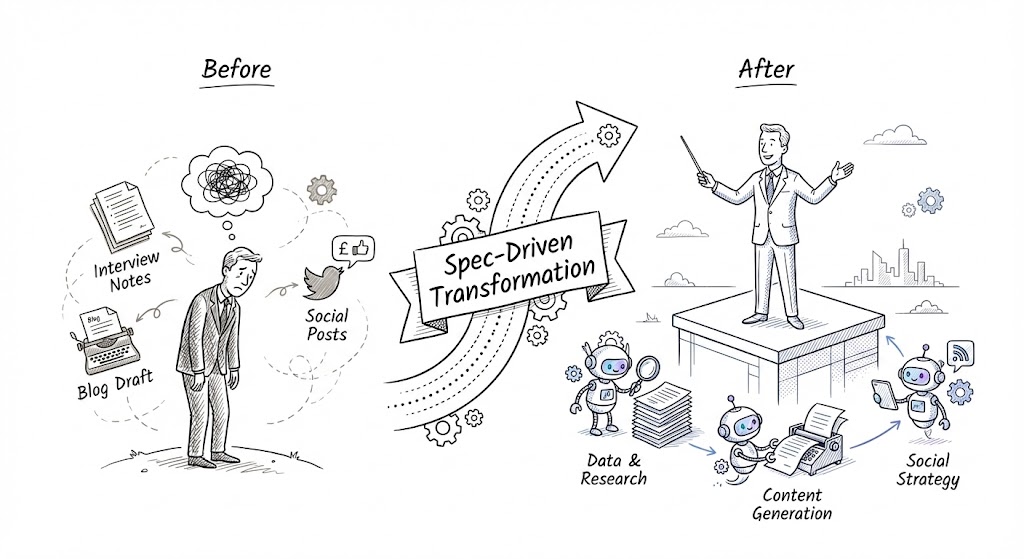
The Professional Transition: From Executor to Orchestrator
The deeper transformation these kits enable isn't about tools—it's about professional identity and value creation.
Old Professional Model: Your value comes from doing the work: conducting customer interviews, writing blog posts, crafting tweets. Capacity is limited by your personal bandwidth.
New Professional Model: Your value comes from specifying the work precisely enough that agents can execute it within your quality standards. Capacity multiplies through effective orchestration.
The Career Implication
As one of the research documents eloquently frames it: "You're not obsolete. You're promoted."
The professionals who thrive in the next five years won't be those who resist AI agents or those who blindly adopt them. They'll be those who develop the new core competency: constitutional engineering—the ability to encode professional expertise into specifications that AI agents can execute while maintaining human judgment at strategic decision points.
For Product Managers: From conducting customer interviews → to designing systematic validation workflows that agents help execute
For Content Strategists: From writing individual posts → to architecting content strategies that agents help produce at scale
For Marketing Professionals: From posting on social media → to orchestrating multi-channel campaigns that agents help amplify
Practical Starting Points for Cross-Functional Adoption
If you're a professional in product, content, marketing, or related disciplines, you can adopt spec-driven workflows in a few deliberate steps:
6-Month Adoption Path
| Months | Focus | What You Actually Do |
|---|---|---|
| 1–2 | Single Project Pilot | Pick one project in your domain, run it end-to-end with the relevant kit (constitution → spec → plan → tasks → implementation), and write down what worked and what broke. |
| 3–4 | Pattern Recognition | Apply the method to 2–3 more projects, notice recurring patterns in your specs, turn them into simple templates, and start a lightweight knowledge base. |
| 5–6 | Team Scaling | Share the method with your team, create shared constitutions, add quick specification reviews, and begin tracking a few productivity/quality metrics. |
Make It Cross-Functional
- Share specs between product and marketing for launches.
- Use common strategic frameworks between content and product for messaging.
- Align engineering and product around the same specification formats.
The more functions speak the same spec language, the less time you spend relitigating context.
Invest in Constitutions, Not Just Tasks
Use early projects to start encoding your best judgment into reusable constitutions:
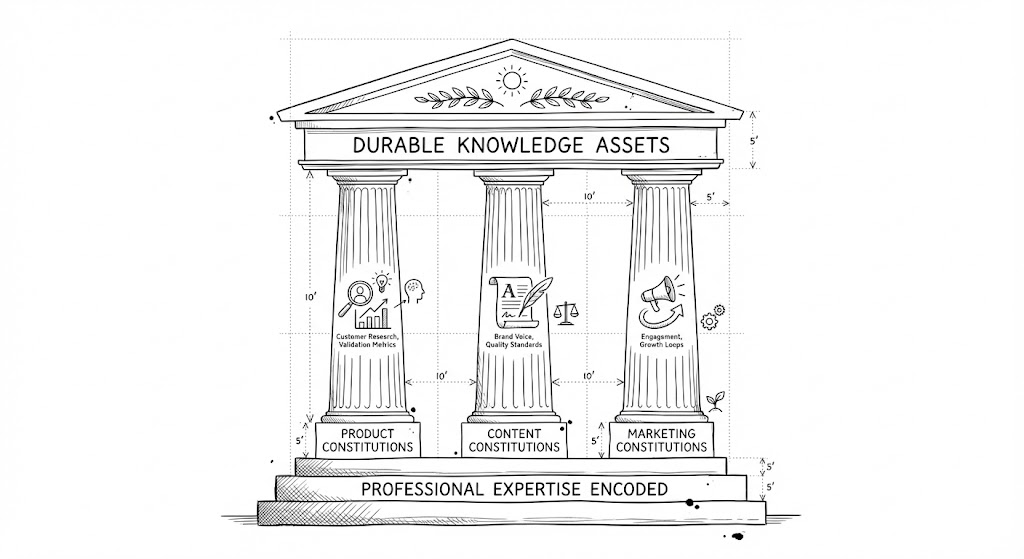
- Product Constitutions: Research methodologies, segment definitions, PMF metrics, and positioning principles.
- Content Constitutions: Brand voice and editorial standards, quality and review thresholds, SEO and audience guidelines.
- Marketing Constitutions: Campaign objectives and success criteria, authentic voice rules, engagement protocols, and growth loop hypotheses.
These constitutions compound over time as IP—frameworks that let new projects and new team members plug into the same standards from day one.
Ready to Begin?
Explore the three featured kits and discover how spec-driven methodology applies to your professional domain:
- PMF-Kit: Systematic product-market fit discovery for product professionals — github.com/agentii-ai/pmf-kit
- Blog-Tech-Kit: Strategic content authority building for marketing and editorial teams — github.com/agentii-ai/blog-tech-kit
- Twitter-Init-Kit: Founder-led audience development for growth and communications professionals — github.com/agentii-ai/twitter-init-kit
Each kit shares the same proven foundation while adapting to the unique requirements of its domain. Start with the kit most aligned to your immediate challenge, master the methodology, then expand to related functions.
Your expertise isn't obsolete. It's becoming exponentially more valuable—when combined with the right methodology for leveraging AI agents systematically.
The spec-driven revolution is transforming how professionals work across disciplines. These three kits demonstrate the power of applying rigorous methodology to domains traditionally governed by intuition and improvisation. For comprehensive implementation guidance and specialized toolkit resources, visit agentii-kit.dev.
AgentII Team
Expert contributor to the Agentii blog sharing insights on AI-powered financial analysis and automation.
Related Articles
Every Job. One Method: Spec-Driven Development Beyond Code
Discover how spec-driven development transforms every role—from marketing to legal to HR. Learn why the same methodology works for any knowledge work.
Don't Code. Specify: How Spec-Driven Development Gets 95% Accuracy on the First Try
Why spec-driven development hits 95% first-pass accuracy—and how to shift from vibe coding to a specification-first workflow.
The Leadership Imperative: Transforming Your Organization for the Agentic Era
Why C‑suite leaders have a 24‑month window to redesign structures, workflows, and talent for agentic AI or risk permanent competitive decline.