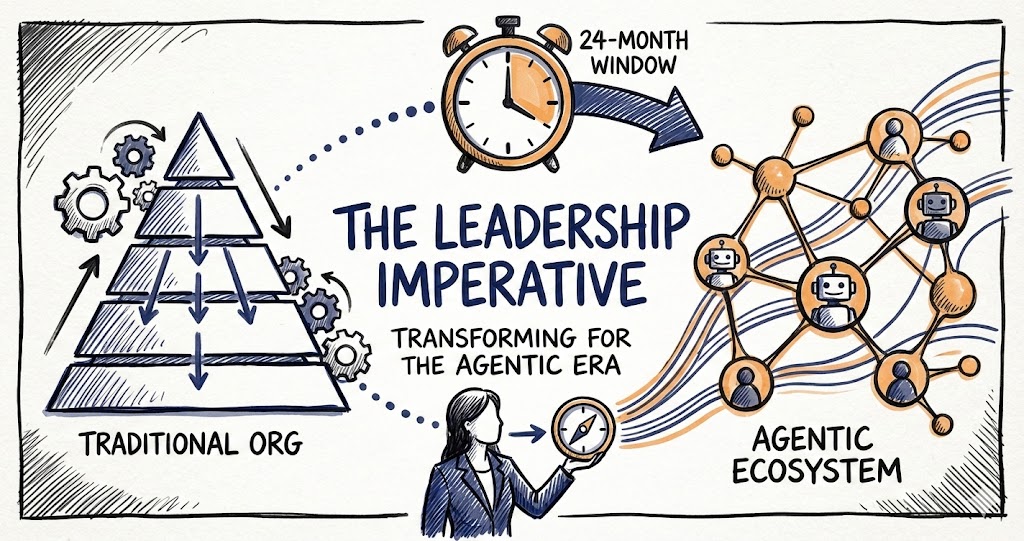
The Leadership Imperative: Transforming Your Organization for the Agentic Era
The window to adapt is closing. Organizations have approximately 24 months to fundamentally restructure how they operate before the competitive gap becomes insurmountable.
For the past decade, enterprise AI adoption has been largely additive—new tools layered onto existing processes, new capabilities embedded within familiar workflows. The emerging agentic era represents something fundamentally different: a complete reimagining of organizational structure, decision-making patterns, and talent deployment.
This isn't about deploying chatbots or automating repetitive tasks. This is about reorganizing your entire enterprise around AI agents as first-class participants in strategic work.
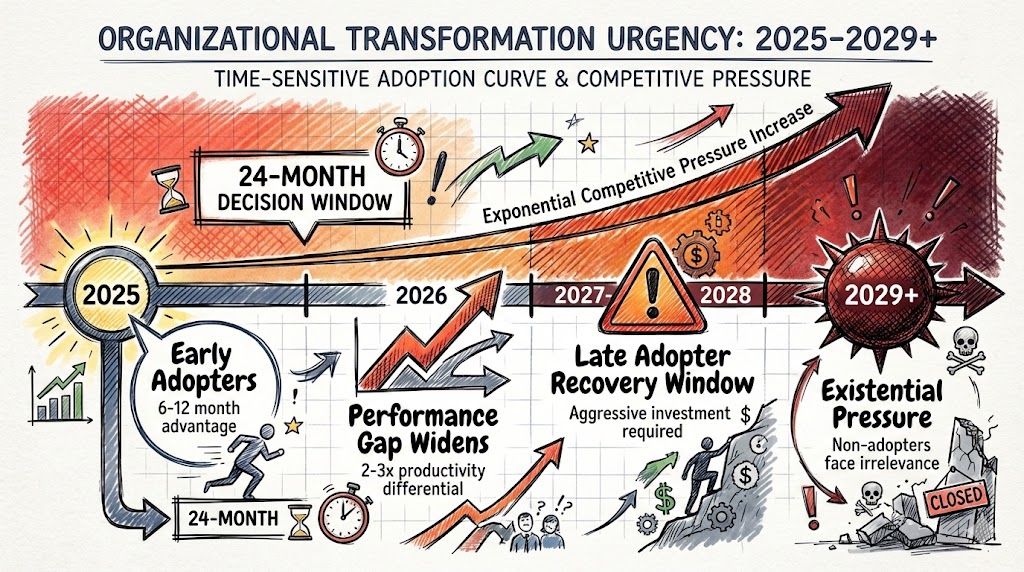
The Urgency: Why 2025-2026 Is Your Decision Window
Recent analysis from McKinsey's executive AI insights and leading research firms reveals a compressed adoption timeline that differs markedly from previous technology transitions. Organizations face a 24-month framework for navigating the AI transformation that will separate market leaders from those struggling to survive:
- 2025: Early adopters gain 6-12 month competitive advantages, establishing foundation and deploying initial agent capabilities1
- 2026: The performance gap widens to 2-3x productivity differentials as automation advantages compound exponentially—not gradually2
- 2027-2028: Late adopters can still recover with aggressive transformation investment, shifting from activity metrics to P&L impact3
- 2029+: Non-adopters face existential competitive pressure as the gap becomes insurmountable
Unlike previous technology shifts that allowed gradual adoption over 5-7 years, the agentic transformation demands decisive action within a 24-month window. Thomson Reuters research reveals the stakes: organizations with visible AI strategies are twice as likely to experience revenue growth compared to those with informal or ad hoc approaches, and 3.5 times more likely to experience critical benefits compared to organizations with no significant adoption plans.4
Why This Timeline Is Different
Previous enterprise transformations—cloud migration, digital transformation, agile adoption—were fundamentally additive. They enhanced existing organizational capabilities without requiring structural reorganization.
Agentic transformation is transformative. Microsoft's research on "Frontier Firms" reveals that organizations leading in AI transformation achieve returns three times higher than slow adopters, with 77% planning custom AI solutions within 24 months.5 It fundamentally changes:
- Who participates in decision-making (humans + agents working in collaborative teams)
- How work flows through the organization (parallel vs. sequential execution that reduces processing time and eliminates bottlenecks)6
- Where accountability resides (systemic vs. individual, requiring new approaches to organizational culture)7
- What skills create value (orchestration vs. execution, with 70-80% of non-technical employees capable of transitioning to agent orchestration roles)8
Organizations that delay transformation aren't just missing efficiency gains—they're ceding fundamental competitive positioning to more agile competitors who are establishing uncatchable advantages that compound over time.9
The Four Pillars of Organizational Transformation
1. Structural Reorganization: From Org Charts to Work Charts

| Aspect | Traditional Org | Agentic Org | Key Evidence |
|---|---|---|---|
| Structure | Hierarchy, functional silos, human-only teams | Outcome-based, cross-functional value streams, human–agent teams | McKinsey on agentic organizations10 |
| Workflow | Linear, sequential, bottlenecked | Parallel execution with agents handling routine work | Case studies of cross-functional AI teams11 |
| Team Design | 10-person human teams | 3 humans orchestrating 50–100 agents | MIT & enterprise case studies show ~60% productivity gains and 3–5x output1213 |

Implementation Pattern: Strategic humans set direction, orchestrators coordinate agents, agents execute, and quality humans validate—turning traditional teams into high-leverage human–agent systems.
2. Communication Revolution: From Email Chains to Agent Networks
| Dimension | Current State | Agentic State | Key Evidence |
|---|---|---|---|
| Executive Time | 40–60% spent on coordination meetings and email chains | Agents handle routine coordination; leaders focus on strategy and exceptions | BCG on agentic enterprise platforms14 |
| Workflow | Sequential handoffs, frequent bottlenecks | Parallel, agent-to-agent workflows reduce cycle time and improve utilization | Research on parallel workflows15 |
Critical Protocols: Context sharing, peer negotiation, workflow orchestration, network formation, and human–agent interfaces together enable agents to manage ~80% of routine organizational communication while executives focus on high-leverage decisions.
3. Talent Strategy: From Task Execution to Agent Orchestration
| Focus | Shift | Key Evidence | Implication |
|---|---|---|---|
| Skills | From "doing the work" to constitutional engineering and agent orchestration | Spec-driven development protects against tool churn and accelerates onboarding1617 | Invest in people who can encode processes and standards, not just operate tools. |
| Reskilling | 4-phase path from literacy → automation → agent design → orchestration | 77% of executives expect major upskilling; 70–80% of non-technical staff can become orchestrators1819 | Design structured reskilling programs emphasizing learning agility. |
| Talent Constraints | AI talent shortages in IT and architecture roles | ~50% of IT leaders report AI talent as a bottleneck20 | Prioritize building "specification architect" and agent-ops capabilities. |
Emerging Roles: Chief Constitutional Officer, VP of Agent Operations, and Director of Human–Agent Relations formalize accountability for these new capabilities.
4. Cultural Transformation: From Individual Accountability to Systems Thinking
| Element | Old Model | Agentic Model | Key Evidence |
|---|---|---|---|
| Accountability | Individual blame: "Who made the mistake?" | Systems thinking: "Why did our system allow this outcome?" | McKinsey on culture shifts in agentic organizations21 |
| Performance | Punitive accountability triggers threat response and lowers performance | Systems-based accountability improves performance, collaboration, and innovation | Neuroscience on accountability and threat response22 |
| Transformation Risk | Focus only on structure; culture left unchanged | Sustained cultural work needed alongside structural change | ~70% of large transformations stall or miss goals23 |
Practical Shift: Move performance conversations from individual blame to specification quality and process design, with executives explicitly sponsoring culture work—not just org charts.
Implementation Roadmap: The 24-Month Transformation
Organizations that embed AI initiatives into broader transformation agendas show 7 percentage points higher probability of success compared to isolated pilots.24 The roadmap below reflects best practices from successful enterprise transformations. For a cross-functional view of how spec-driven workflows show up in product, content, and marketing execution, see Three Domains, One Method as a companion piece to this leadership roadmap.
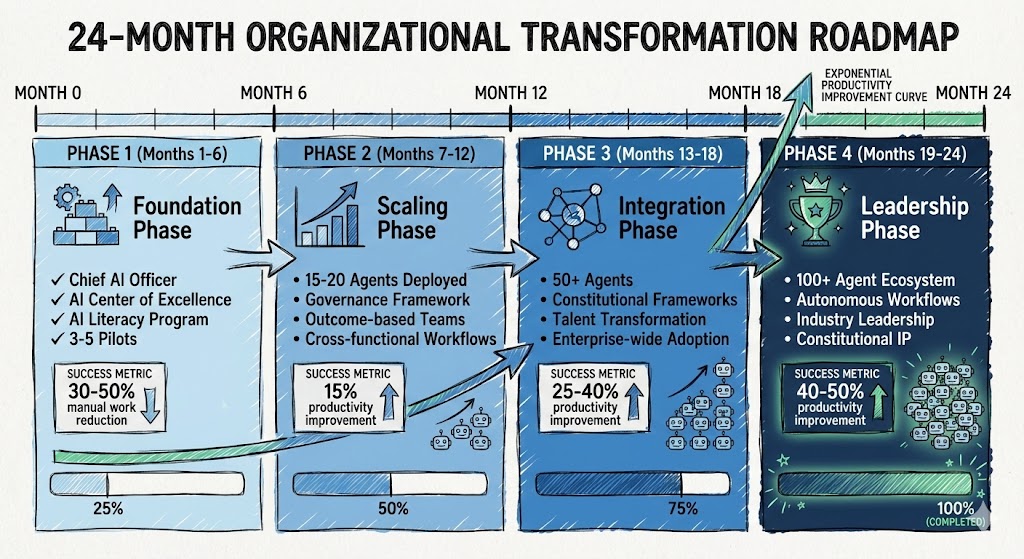
Months 1-6: Foundation Phase
Leadership Actions
- Designate Chief AI Officer or equivalent C-suite role
- Establish AI Center of Excellence with dedicated budget
- Launch enterprise-wide AI literacy program
- Identify 3-5 pilot processes for agentic implementation
Success Metrics
- 80% of leadership team completes AI literacy training
- Pilot agents reduce manual work by 30-50% in target processes (validated by finance teams achieving 85% reduction in close cycle times)25
- Clear ROI demonstration for board and stakeholder communication
Critical Reality Check: Organizations using purchased specialized vendor solutions succeed 67% of the time, while internal builds succeed only 33% of the time—a critical vendor partnership decision that significantly impacts success rates.26
Months 7-12: Scaling Phase
Organizational Changes
- Deploy 15-20 agents across multiple business functions
- Establish agent governance framework and performance metrics
- Begin structural pilots with outcome-based teams
- Implement first cross-functional agentic workflows
Success Metrics
- 30-50% of routine work handled by agents
- 15% productivity improvement in pilot departments
- Agent uptime and reliability exceeding 99%
Months 13-18: Integration Phase
Enterprise Transformation
- Scale to 50+ agents across full organization
- Transition from functional to outcome-based organizational structure
- Implement constitutional frameworks for major business domains
- Launch advanced talent transformation programs
Success Metrics
- 60-80% of routine work autonomous
- 25-40% overall productivity improvement
- 75%+ success rate in employee reskilling programs
Months 19-24: Leadership Phase
Strategic Positioning
- Deploy 100+ agent enterprise ecosystem
- Implement fully autonomous workflows with human oversight
- Establish industry leadership position in agentic practices
- Develop proprietary competitive advantages through constitutional IP
Success Metrics
- 80%+ routine work autonomous
- 40-50% productivity improvement
- Industry recognition as agentic transformation leader
Risk Mitigation: Addressing Executive Concerns
| Executive Concern | Reality | Strategy | Key Evidence |
|---|---|---|---|
| Job Displacement | Well-executed transformations reassign tasks more than they remove people; anxiety spikes when change is poorly explained. | Frame changes as "replacing tasks, not people"; provide clear reskilling paths and emphasize human–AI collaboration (executor → supervisor → orchestrator). | Forbes on reskilling and "tasks not people"2728; Trinetix & Ambush on role anxiety and failed AI adoption when change is forced without management2930 |
| Loss of Control | Agentic systems require more structured governance, not less; liability and compliance questions are still evolving. | Implement governance from day one: clear escalation, human override, and constitutional guardrails reviewed by expert committees. | Nemko & CloudEagle on modern AI governance3132; Sparkco on constitutional AI frameworks33 |
| Competitive Differentiation | Tools commoditize; encoded expertise (constitutions and specs) and learning speed become defensible IP. | Treat constitutional engineering as a core competency; invest in systems that make AI use visible and measurable. | AugmentCode on spec-driven advantages34; GTM AI Podcast on hidden actual adoption rates and visibility gaps35 |
The Competitive Landscape: Winners vs. Laggards
Organizations Successfully Transforming
Characteristics
- Executive commitment backed by dedicated budget allocation
- Investment in specification discipline as core competency
- Systematic talent transformation rather than wholesale replacement
- Clear metrics and accountability for transformation progress
- String-of-pearl approach connecting use cases to build organizational capability more effectively than dozens of unrelated pilots36
Competitive Advantages
- 4-5x execution speed in key processes (validated by financial services achieving 3x faster issue resolution)37
- 30-50% cost reduction through intelligent automation (healthcare cases demonstrating 30-50% savings in specific processes)38
- Enhanced capability to pursue previously infeasible initiatives
- Superior talent attraction for AI-native workforce
Critical Implementation Reality: While productivity gains are achievable, 95% of generative AI pilots fail to achieve rapid revenue acceleration, with the vast majority stalling and delivering little measurable P&L impact. The difference between success and failure stems from organizational integration and learning capabilities, not technology alone.39
Organizations Falling Behind
| Signal Type | Indicators of Falling Behind | Key Statistics |
|---|---|---|
| Behavioral Warning Signs | AI treated as bolt-on tool, not transformation catalyst; minimal investment in learning; resistance to structural change; difficulty attracting AI-native talent. | 46% of AI projects are abandoned between proof of concept and broad adoption40. |
| Business Consequences | 4–5x slower execution vs. transformed peers; rising relative operating costs; talent attrition to AI-augmented organizations; eroding market position. | 80% of leaders report no tangible EBIT impact from GenAI, and 46% see no strong positive impact on any single objective4142. |
ROI Reality Check: The gap between adoption and financial impact underscores that execution excellence and organizational learning—not mere experimentation—determine competitive outcomes.
Strategic Recommendations for C-Suite Leaders
Immediate Actions (Next 90 Days)
- Assess Current State: Conduct enterprise-wide readiness assessment for agentic transformation
- Secure Resources: Allocate dedicated budget and executive sponsor for transformation initiative
- Build Coalition: Identify and prepare transformation champions across all major business functions
- Start Learning: Begin executive team education on agentic principles and competitive implications
Critical Success Factors
- Executive Commitment: Transformation must be visible, funded, and championed at the highest levels
- Specification Excellence: Investment in clear, precise process documentation becomes competitive advantage
- Cultural Courage: Willingness to fundamentally restructure rather than incrementally improve
- Talent Investment: Systematic reskilling and development rather than wholesale replacement
The question is not whether agentic transformation will occur—it's whether your organization will lead, follow, or become irrelevant.
Ready to Begin Your Transformation?
The organizations that act decisively in 2025 will establish competitive advantages that compound over decades. Those that delay will find themselves permanently disadvantaged.
Start with assessment. Move to pilot implementation. Scale systematically.
Your competition already is.
References
Footnotes
-
McKinsey, "The Change Agent Goals for CEOs in the Agentic Age" ↩
-
LinkedIn, "AI Automation Playbook: 24-Month Framework" ↩
-
McKinsey, "The Change Agent: Roadmap for Agentic Transformation" ↩
-
Thomson Reuters, "AI Adoption Reality Check" ↩
-
Microsoft, "Bridging the AI Divide: Frontier Firms" ↩
-
Lowcode Agency, "Parallel Workflow in Automation" ↩
-
Forbes, "Workforce Reskilling in the Agentic AI Era" ↩
-
GTM AI Podcast, "Why 88% AI Adoption Actually Matters" ↩
-
McKinsey, "The Agentic Organization" ↩
-
Naitive, "Cross-Functional AI Teams vs Traditional Teams" ↩
-
Demand Gen Report, "AI Agents Boost Productivity Without Sacrificing Performance" ↩
-
Enterprise AI Executive, "20 Must-Read AI Agents Case Studies" ↩
-
BCG, "How Agentic AI Is Transforming Enterprise Platforms" ↩
-
Lowcode Agency, "Parallel Workflow in Automation" ↩
-
AugmentCode, "Spec-Driven Development with AI Agents" ↩
-
LinkedIn, "Agent-First Enterprise: Why Clear Requirements Matter" ↩
-
KPMG, "AI Agents Shaping Talent Strategy" ↩
-
Forbes, "Workforce Reskilling in the Agentic AI Era" ↩
-
Trinetix, "AI Adoption Challenges" ↩
-
McKinsey, "The Agentic Organization" ↩
-
NeuroLeadership, "Creating a Culture of Accountability" ↩
-
Agile Seekers, "How Leaders Can Use AI to Accelerate Change" ↩
-
Master of Code, "AI in Finance: Use Cases and Examples" ↩
-
S&P Global, "AI Experiences Rapid Adoption But With Mixed Outcomes" ↩
-
Forbes, "Workforce Reskilling in the Agentic AI Era" ↩
-
The Interview Guys, "The Rise of Human-AI Collaboration" ↩
-
Trinetix, "AI Adoption Challenges" ↩
-
Ambush, "Why AI Adoption Fails" ↩
-
Nemko, "Modern AI Governance Frameworks" ↩
-
CloudEagle, "AI Governance Framework Explained" ↩
-
Sparkco AI, "Implementing Constitutional AI in Enterprise" ↩
-
AugmentCode, "Spec-Driven Development with AI Agents" ↩
-
GTM AI Podcast, "Why 88% AI Adoption Actually Matters" ↩
-
Enterprise AI Executive, "20 Must-Read AI Agents Case Studies" ↩
-
PMC, "Healthcare AI Applications" ↩
-
Fortune, "95% of GenAI Pilots Failing" ↩
-
S&P Global, "AI Experiences Rapid Adoption But With Mixed Outcomes" ↩
-
Trinetix, "AI Adoption Challenges" ↩
-
S&P Global, "AI Experiences Rapid Adoption But With Mixed Outcomes" ↩
AgentII Team
Expert contributor to the Agentii blog sharing insights on AI-powered financial analysis and automation.
Related Articles
Every Job. One Method: Spec-Driven Development Beyond Code
Discover how spec-driven development transforms every role—from marketing to legal to HR. Learn why the same methodology works for any knowledge work.
Three Domains, One Method: How Spec-Driven Workflows Are Transforming Product, Content, and Marketing
How PMF‑Kit, Blog‑Tech‑Kit, and Twitter‑Init‑Kit use one spec‑driven method to transform product, content, and marketing into agent‑ready workflows.
Don't Code. Specify: How Spec-Driven Development Gets 95% Accuracy on the First Try
Why spec-driven development hits 95% first-pass accuracy—and how to shift from vibe coding to a specification-first workflow.