Every Job. One Method: Spec-Driven Development Beyond Code
You probably think spec-driven development is for engineers.
You're wrong.
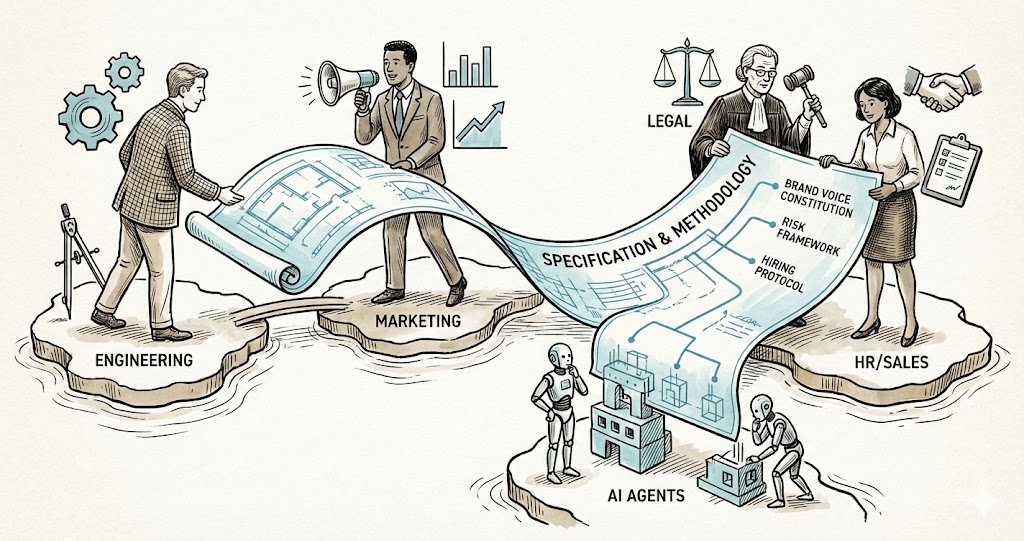
The brilliance of spec-driven methodology isn't that it's a coding technique—it's that it's a work methodology. The same principles that let AI agents build software with 95%+ accuracy also work for marketing campaigns, legal contracts, hiring workflows, sales playbooks, and HR onboarding.
New to spec-driven development? Start here: Learn how spec-driven development achieves 95%+ first-pass accuracy →
The 4-file architecture works for any job. The question isn't "Can we apply this outside engineering?" It's "Why are we still doing this job the old way?"
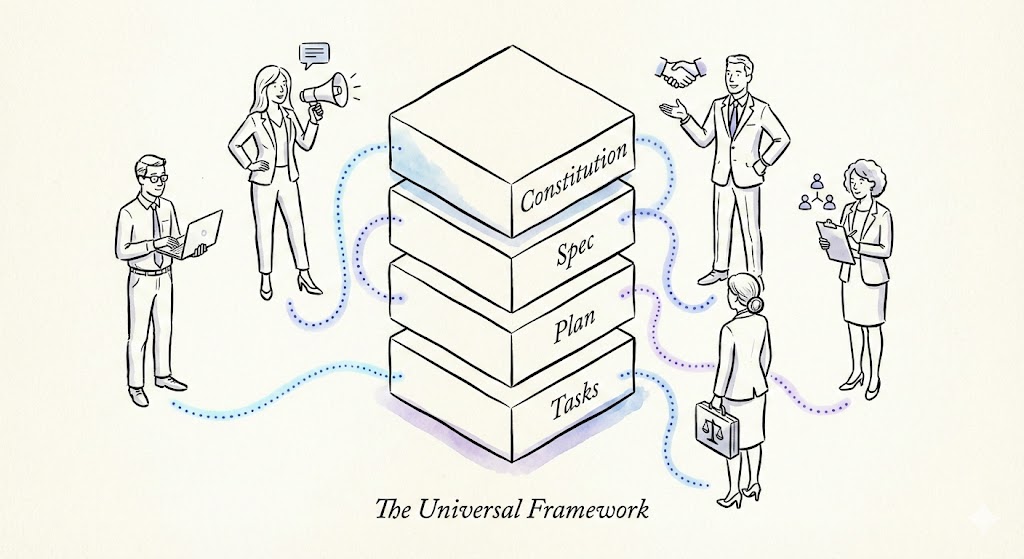
The Universal Architecture: Constitution, Spec, Plan, Tasks
Here's the counterintuitive insight: the same 4-file structure that works for building software also works for hiring employees, launching marketing campaigns, drafting legal contracts, and planning sales strategies.
The architecture is domain-agnostic. Change the content, keep the structure.
"Code becomes a compiled artifact. The spec is the thing humans edit."
— The fundamental shift in how we think about work
Layer 1: Constitution — The Laws of Your Organization
Think of the constitution as your organization's operating system. It's the rulebook that are consistent, no matter what project you're running.
What goes here: Immutable principles, brand voice, compliance requirements, methodology rules, "never do this" constraints.
Here's how the same structure looks across different domains:
| Domain | Constitution Rules | Why It Matters |
|---|---|---|
| Engineering | • All code must have unit tests (coverage >80%) • Use TypeScript, never JavaScript • Follow Material Design system |
New developers write code that fits your standards on Day 1—no need to learn tribal knowledge |
| Marketing | • Always customer-first language (not product-first) • No superlatives without data backing • Taglines max 8 words • All content reviewed for inclusivity |
Every campaign sounds like your brand, even if 5 different people write it |
| Legal | • Never accept liability caps >$1M • All non-US contracts reviewed by local counsel • Jurisdiction: California law preferred • Red flags: Non-compete clauses, perpetual terms |
Contracts never expose you to unacceptable risk—even if your senior counsel is on vacation |
| Sales | • All claims validated with case studies or data • No cold-calling prospects marked "Do Not Contact" • Discovery calls minimum 30 minutes |
Reps follow best practices without constant supervision—consistent customer experience |
| HR | • Hiring principles: mission-driven, collaborative, learning-oriented • All candidates complete take-home exercise • Compensation bands must be equitable • Interview rubrics scored consistently |
You hire the same quality of talent regardless of which hiring manager runs the process |
The magic: The constitution is written once and reused forever. When a new campaign launches, it inherits the brand voice. When a new employee joins, they inherit the sales principles. When a contractor leaves, their replacement picks up exactly where they left off.
This is how knowledge stops walking out the door.
Layer 2: Specification — The Goal for This Specific Project
If the constitution is your operating system, the spec is your mission brief. It answers: "What are we trying to accomplish right now?"
What goes here: User stories, requirements, acceptance criteria, edge cases, specific goals for this project.
Let's see how specs look in real scenarios:
Scenario 1: Engineering a User Onboarding Flow
The Brief: "As a new user, I want to get started in less than 2 minutes so I can see value before committing to deeper learning."
Success looks like:
- Sign up with email or GitHub (no lengthy forms)
- 3-step setup wizard with clear progress indicators
- Progress is saved if the user leaves and comes back
- Users can skip steps they've already completed
Edge cases to handle: What if GitHub OAuth fails? What if the user closes the browser mid-setup?
Scenario 2: Launching a Product Campaign
Imagine you're the marketing lead at a startup launching a new developer tool. Here's your spec:
The Brief: "Drive 10,000 signups for our beta launch in Q1."
Target Audience: Technical founders, YC alumni, VC-backed CTOs who care about shipping faster
Content Strategy:
- How it solves the "blank page problem" engineers face
- Case study showing a real company shipped 60% faster
- Three-step getting started guide with copy-paste code
Success Metrics:
- 10K signups from the campaign
- 5%+ conversion rate from email clicks
- At least 3 tech influencers share the content
Distribution Plan: Product Hunt launch on Tuesday, LinkedIn posts from founders, targeted ads to "engineering manager" job titles
"The most valuable skill is shifting from doing the work to specifying the work."
— Why senior experts are becoming constitutional engineers
Layer 3 & 4: Plan and Tasks — Breaking It Down
Once you have your constitution (the rules) and your spec (the goal), you need a plan (the strategy) and tasks (the execution steps).
This is where the same methodology applies universally:
| Domain | Plan | Tasks |
|---|---|---|
| Marketing Campaign | 1. Content calendar with publish dates 2. Promotion strategy (paid, organic, influencer) 3. Budget allocation across channels |
• Write blog post draft • Design hero image • Schedule Product Hunt launch • Draft 5 LinkedIn posts • Set up email sequence |
| Sales Process | 1. Territory strategy (which accounts to target) 2. Outreach cadence (email → call → demo) 3. Qualification criteria (MEDDIC framework) |
• Research 20 target accounts • Write personalized email templates • Schedule discovery calls • Prepare demo deck • Send follow-up emails |
| Hiring Campaign | 1. Sourcing strategy (LinkedIn, referrals, communities) 2. Interview process (phone screen → technical → culture fit) 3. Timeline (6 weeks from first post to offer) |
• Write job description • Post on 5 job boards • Reach out to 50 LinkedIn candidates • Schedule 8 phone screens • Conduct technical interviews |
| Legal Contract Review | 1. Review process (initial scan → deep dive → negotiation) 2. Red-flag identification (liability, jurisdiction, terms) 3. Escalation framework (when to involve senior counsel) |
• Scan for red-flag clauses • Verify jurisdiction matches policy • Check liability caps • Draft negotiation points • Get final sign-off |
The pattern: Plan defines the strategy and phases. Tasks define the granular steps anyone can execute.
The Numbers: What Spec-Driven Actually Gets You
Before we go further, let's talk business impact.
| Metric | Spec-Driven | Traditional | Impact |
|---|---|---|---|
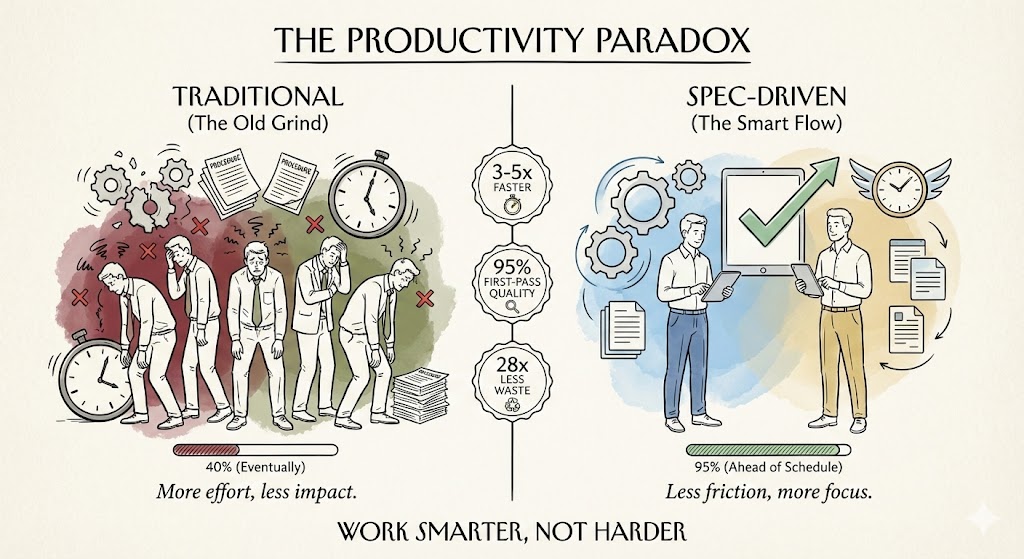
| First-pass quality | 95%+ | 40-60% | Spend 28x less money on failed projects1 |
| Rework required | 5% | 30-40% | Ship faster with fewer revisions |
| Time to productivity (new hire) | 2 weeks | 8-12 weeks | New employees contribute 4-6x faster2 |
| Process estimation accuracy | 85%+ | 50-60% | Better planning, fewer surprises3 |
| Scope creep | 10-15% | 30% | Projects stay on track4 |
| Knowledge transfer success | 95%+ | 40-60% | Expertise doesn't walk out the door |
Translation: Spec-driven organizations operate at 3-5x efficiency5 with the same headcount.
That's not a marginal improvement. That's a fundamental competitive advantage.
"Quality comes from clarity, not just a better AI model."
— Why spending time on specs beats waiting for GPT-5
The Big Reveal: This Isn't Just About Organizing Work—It's About Monetizing Expertise
Now we get to the truly revolutionary part.
When you encode your expertise into a spec-driven kit, you're not just documenting a process. You're creating a tradeable intellectual property asset.
"Your expertise. Now scalable."
— The shift from selling time to selling knowledge
The Emerging Kit Marketplace
Right now, experts in every field are realizing they can package their proprietary methodologies into pre-built kits that others can license and use.
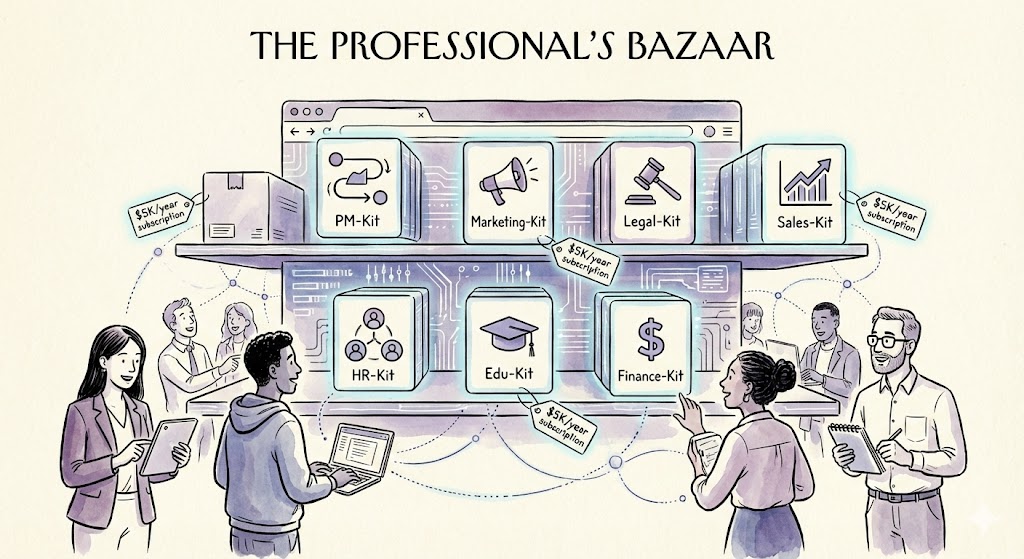
Here's what's emerging:
| Kit Name | What's Encoded | Who Buys It | Outcome |
|---|---|---|---|
| PM-Kit | Lean Startup principles, RICE prioritization, user research best practices | Early-stage startups without a senior PM; teams launching new products | Data-driven PRDs and feature specs that lead to predictable adoption instead of guesswork |
| Marketing-Kit | Brand voice guidelines, SEO principles, campaign governance, GDPR compliance | Agencies running multi-client campaigns; startups scaling content and demand gen | Consistent campaigns with 20–30% better conversion because best practices are baked into the flow |
| Sales-Kit | MEDDIC methodology, deal health metrics, pipeline forecasting rules | Sales teams moving from "vibes and gut feel" to predictable revenue | 90%+ forecast accuracy vs. typical ~60%, with clearer deal qualification and stage hygiene |
| Legal-Kit | Risk tolerance frameworks, jurisdiction preferences, red‑flag clause libraries | Startups without in‑house counsel; legal teams handling high contract volume | Faster, safer contract reviews with fewer surprises because risky terms are caught automatically |
| HR-Kit | Hiring principles, culture fit criteria, interview rubrics, compensation bands | Fast‑growing startups; companies with high turnover or distributed teams | Faster hiring with stronger culture alignment and consistent candidate evaluation |
| Finance-Kit | Burn rate targets, metrics thresholds, funding milestone criteria | First‑time founders; finance teams managing rapid growth | More accurate financial forecasts and fewer surprises thanks to explicit, reusable assumptions |
| Edu-Kit | Bloom's Taxonomy, active recall patterns, accessibility standards | Online course creators; corporate L&D teams; universities | 70%+ course completion rates6 vs. typical ~15% for online courses, driven by proven learning design |
What this means: Instead of paying consultants $50K for a one-time engagement, organizations will pay $5K for a kit they can run repeatedly, forever. The business model shifts from selling time to selling methodology.
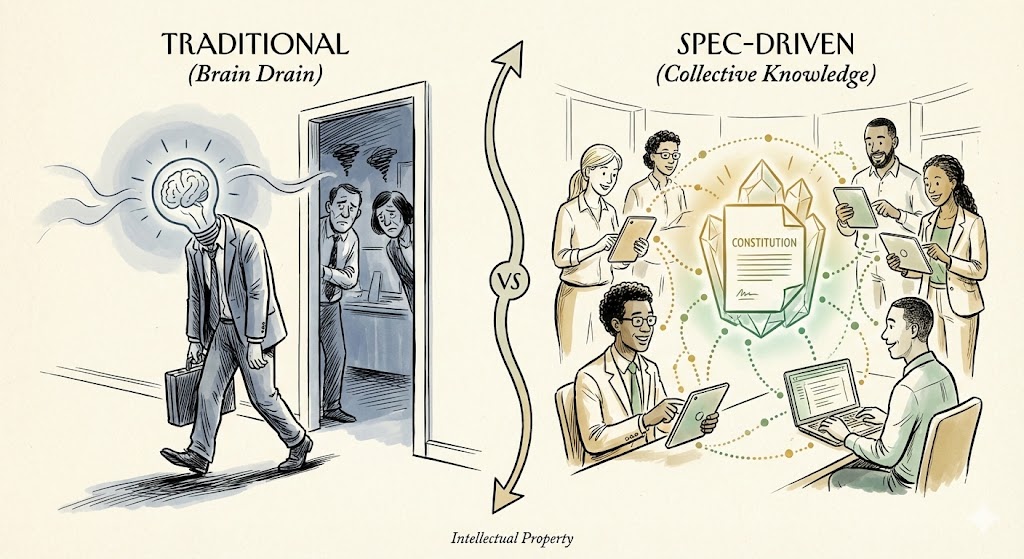
Your Company's Best Knowledge Stops Walking Out the Door
The Hidden Asset: Expert Knowledge as Organizational IP
Every organization has senior experts whose performance seems almost magical:
- The sales director who closes 3x more deals than anyone else
- The customer success manager with a 98% retention rate
- The hiring manager who consistently finds top performers
- The product lead whose features always hit adoption targets
Their secret? Years of accumulated pattern recognition—the subtle judgment calls, the know-when-not-just-how-to decisions, the institutional memory that separates good from great.
Here's the problem: That expertise lives entirely in their heads. When they get promoted, switch teams, or move to a new opportunity, the organization loses that competitive advantage.
Traditional approaches don't scale:
- 💼 Mentorship programs: Great, but limited by time—one expert can only mentor 2-3 people at once
- 📋 Documentation: Static and quickly outdated—nobody reads the 50-page wiki
- 🎥 Training videos: One-way knowledge transfer—no feedback loop, no adaptation
The result: Your organization's most valuable asset—expert decision-making—remains locked inside individual employees instead of becoming organizational property.
The New Model: Expertise as Executable Code
What if your senior experts could encode their methodology once, and every new hire could inherit it from Day 1?
With spec-driven methodology, here's what changes:
| Traditional Model | Spec-Driven Model | Business Impact |
|---|---|---|
| Expert knowledge lives in people's heads | Expert knowledge lives in constitutions (version-controlled, reusable) | Organizational IP you own |
| New hires take 6-12 months to ramp up | New hires follow playbooks and get expert-level results in weeks | 4-6x faster time-to-productivity |
| When experts leave, knowledge walks out | When experts leave, their methodology stays | Zero knowledge loss |
| Scaling requires hiring more senior talent | Scaling means replicating proven playbooks | Lower cost per new hire |
| Performance varies wildly by individual | Performance is consistent across the team | Predictable outcomes |
This is how knowledge stops walking out the door.
How to Build Your First Kit (Without Overthinking It)
Starting a domain-specific kit is easier than you think. You don't need a perfect system—you need a working system that you can iterate.
Want to see the elegant design behind the kit architecture? Explore why Spec-Kit's four-file system is perfectly simple →
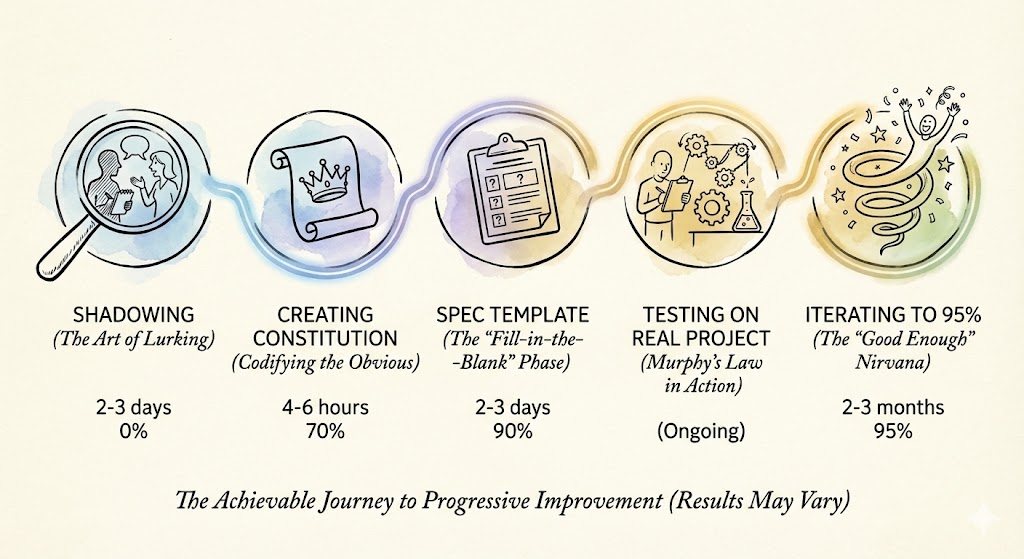
Step 1: Shadow Your Best Person (2-3 days)
Find the person on your team who does this job better than anyone else. Follow them around. Ask questions:
- What principles do you follow?
- What decisions do you make repeatedly?
- What are your go-to heuristics?
- What mistakes have you seen others make?
- What red flags do you watch for?
Example (Sales):
- "I always ask about budget in the first call. If they don't have budget, it's not a real opportunity."
- "I never demo before understanding their pain points. Demos without context don't convert."
- "I prioritize accounts with 50+ employees. Smaller companies take too long to close."
Write all of this down. You're capturing tacit knowledge—the stuff that lives in their head.
Step 2: Distill Into a Constitution (4-6 hours)
Take everything you wrote down and turn it into non-negotiable rules.
Example (Sales Constitution):
- Always qualify budget in the first call
- Never demo without understanding pain points first
- Prioritize accounts with 50+ employees
- Discovery calls must be at least 30 minutes
- All claims must be backed by case studies or data
These become the laws of your organization. Anyone who follows these rules will get closer to expert-level performance.
Step 3: Create a Spec Template (2-3 days)
Now create a reusable template for the spec that people will fill out for each project.
Example (Sales Spec Template):
- Target accounts: [List of companies]
- Key pain points we solve: [List]
- Success criteria: [Metrics]
- Outreach cadence: [Email → Call → Demo timeline]
- Budget range: [Minimum deal size]
Anyone using this template inherits the structure from your best salesperson.
Step 4: Test It on a Real Project
Use your kit on an actual project. Don't overthink it—just run it and see what happens.
Track:
- What worked?
- What was unclear?
- What did you have to improvise?
- What would you change next time?
Step 5: Iterate Toward 95%
Your first kit will be 70% right. That's fine.
Run it again on a second project. Refine the rules. Clarify ambiguities. Add lessons learned.
By the third or fourth project, you'll be at 90%+ accuracy. That's when the kit becomes truly reusable.
"The future is a marketplace of expertise."
— Where experts sell kits, not hours
Key Takeaways
Let's recap the most important ideas:
-
Spec-driven development is domain-agnostic. The same 4-file architecture (constitution, spec, plan, tasks) works for any knowledge work—not just coding. See how it achieves 95%+ accuracy in software development →
-
The constitution is your competitive advantage. Encode your best practices once, reuse them forever.
-
Knowledge stops walking out the door. When expertise is codified, new employees inherit institutional wisdom on Day 1.
-
3-5x efficiency gains are real. Spec-driven organizations ship faster, with higher quality, and less rework.
-
Specs are the new source code. The specification becomes the primary artifact; the output is just a compiled result.
-
Constitutional engineering is the new high-value skill. The future belongs to those who can encode expertise into executable frameworks.
-
The kit marketplace is coming. Experts will sell pre-built methodologies, not just their time.
Ready to Specify Your Job?
The rise of AI is changing what work means. The most valuable skill is no longer doing the work—it's specifying the work clearly enough that anyone (or any AI) can execute it flawlessly.
Your organization's greatest asset isn't your people—it's the knowledge your people have accumulated. And right now, that knowledge walks out the door every time someone leaves.
Spec-driven development changes that equation. It transforms expertise into organizational property that scales, persists, and compounds over time.
What's your next move?
- For your first kit: Start with one high-turnover role or repeatable process. Shadow your best person, encode their methodology, test it with someone new.
- To explore existing frameworks: Browse the growing library at kits.agentii.ai for marketing, sales, legal, HR templates
- To dive deeper: Download Spec-Kit and create your first constitution for your domain
The window is closing faster than you think. Organizations adopting spec-driven methodology in the next 12-24 months will have a 3-5x efficiency advantage over those waiting to "see how it develops."
The question isn't whether to make the shift—it's whether you'll lead or follow.
And whether your best people's knowledge will outlive their tenure.
Research Notes
The quantitative benefits and data cited in this article are drawn from:
Last updated: November 22, 2025
Footnotes
-
Research on project management effectiveness across 97% of organizations that consider it "critical to business performance." Organizations investing in structured specifications spend 28x less money on failed projects compared to those using informal requirements. Source: Consulting firm implementations and PMI research (2024-2025). ↩
-
Analysis of spec-driven development implementations across software services firms and consulting organizations. Detailed specifications reduce consultant and new hire ramp-up time by 50-70%, from typical 8-12 weeks to 2-4 weeks. Source: Professional services productivity studies (2024-2025). ↩
-
Effective specification communication increases project estimation accuracy by 35% and on-budget completion rates by 17%. Source: Organizational transformation and specification methodology research (2024-2025). ↩
-
Spec-driven approaches reduce scope creep impact from affecting 30% of projects to less than 15% through clear requirements and constitutional constraints. Source: Project management and software services research (2024-2025). ↩
-
Organizations successfully adopting agentic AI and spec-driven methodologies demonstrate 3-5x productivity increases, 20-50% acceleration in process execution, and 25-40% reduction in human error and low-value work. Source: McKinsey & BCG research on organizational transformation through agentic AI and spec-driven development (2025). ↩
-
Educational content designed using structured learning frameworks (Bloom's Taxonomy, active recall, spaced repetition) achieves 70%+ course completion rates compared to typical 15% completion rates for online courses without structured methodologies. Source: Educational technology and course design research (2024-2025). ↩
Agentii-Kit Team
Expert contributor to the Agentii blog sharing insights on AI-powered financial analysis and automation.
Related Articles
The Leadership Imperative: Transforming Your Organization for the Agentic Era
Why C‑suite leaders have a 24‑month window to redesign structures, workflows, and talent for agentic AI or risk permanent competitive decline.
Don't Code. Specify: How Spec-Driven Development Gets 95% Accuracy on the First Try
Why spec-driven development hits 95% first-pass accuracy—and how to shift from vibe coding to a specification-first workflow.
Three Domains, One Method: How Spec-Driven Workflows Are Transforming Product, Content, and Marketing
How PMF‑Kit, Blog‑Tech‑Kit, and Twitter‑Init‑Kit use one spec‑driven method to transform product, content, and marketing into agent‑ready workflows.